The Good Delivery List, Decoded: What LBMA Accreditation Actually Verifies (and What It Doesn't)
Every serious gold offer eventually leans on the phrase "LBMA Good Delivery." Sellers use it because buyers assume it settles the quality question on its own: the refiner is on the list, so the bar must be good. That assumption is half right, and the half that is wrong is where gold deals quietly come apart. The Good Delivery List is a real and meaningful standard, but it is an accreditation of an institution, not a certificate for the bar sitting in front of you. This piece breaks down what the list actually verifies, what it deliberately leaves out, and how a desk should use the accreditation without ever outsourcing its own due diligence to it.
What the Good Delivery List Actually Is
The Good Delivery List is the roster of refineries whose large bars are accepted for settlement in the London over-the-counter market, the deepest bullion market in the world. It is maintained by the London Bullion Market Association (LBMA) through its Good Delivery Committee. When a refiner is on the list, its 400-ounce bars can be tendered into the London clearing system without re-assay, which is precisely why the accreditation carries so much commercial weight: a listed refiner's bars are treated as known-quality collateral by vaults, banks, and clearing members.
That acceptance is the whole point of the status. The list exists to make the London market function, not to serve as a global seal of quality. Refiners want on it because London is where bullion clears; the market wants it because nobody can assay every bar crossing a vault threshold.
The Bar Standard, at a Glance
Accreditation is tied to a specific physical standard for the large bar, sometimes called the London Good Delivery bar:
Attribute | Good Delivery requirement |
Nominal weight | 400 troy ounces |
Acceptable weight range | Approximately 350 to 430 troy ounces gross |
Minimum fineness | 995.0 (99.5% gold) |
Required marks | Serial number, refiner's mark, fineness, year of manufacture |
Physical condition | Good appearance, no cavities or extensive irregularities |
The stamping convention matters more than most desk traders realize. The marks are the metadata of the bar: who made it, when, and to what claimed fineness. Everything the London market does downstream, including the decision to accept a bar without melting it, rests on those marks being genuine.
What Accreditation Actually Verifies
Getting on the list, and staying on it, requires a refiner to pass checks in four broad categories:
Technical competence. The refiner must demonstrate, over a sustained history, that its bars consistently meet the physical and fineness standard. The LBMA runs proactive monitoring: listed refiners submit bars for sampling and assaying on a rolling basis through the London vault system, so quality is re-tested continuously rather than certified once.
Institutional standing. The accreditation looks at ownership, management history, financial solvency, and audited accounts. A refiner that is a shell, or that cannot demonstrate a real operating history, does not get on the list.
Responsible sourcing. Since 2012, listed refiners must comply with the LBMA Responsible Sourcing Programme, which aligns refiner policies with the OECD Due Diligence Guidance for responsible mineral supply chains. Refiners provide annual assurance of their compliance. This is a documented-policy commitment, which is not the same thing as verified provenance of every kilogram of feed material.
Market conduct. Refiners can be suspended or removed not only for technical failures (off-spec bars, poor stamping) but for non-technical reasons, including insolvency or breaches of responsible sourcing expectations. Suspension history is public and matters commercially.
So the accreditation verifies something real: an institution with a track record, re-tested output, audited standing, and a sourcing policy aligned to international guidance.
What It Doesn't Verify
The limits are just as specific, and every one of them shows up in real deals:
What buyers often assume | What the list actually does |
"Good Delivery" certifies this specific bar | Accredits the refinery as an institution; individual bars are still tested on entry to London |
The refiner's status is permanent | Refiners are suspended and removed; status must be checked as of today, not as of the offer |
The stamp proves the bar is genuine | Stamps are physical marks and can be forged onto counterfeit bars; a fake 400-ounce bar costs a few hundred dollars to make |
Accreditation covers the refiner's upstream supply | The Responsible Sourcing Programme is an attested policy standard, not a provenance audit of every consignment |
A listed refiner's bars can't be involved in a problem | Accreditation says nothing about the commercial conduct of whoever is offering you the bar today, who may not be the refiner at all |
The last line is the one desks most often miss. A Good Delivery stamp answers a question about manufacture, not about ownership or title. A genuine bar from a listed refiner can be stolen, pledged twice, or offered by someone with no right to sell it, and the accreditation will look exactly as pristine as it did the day it was granted.
Where the Seal Gets Abused
Three abuse patterns recur in gold fraud cases, and all three lean on the buyer's deference to the accreditation:
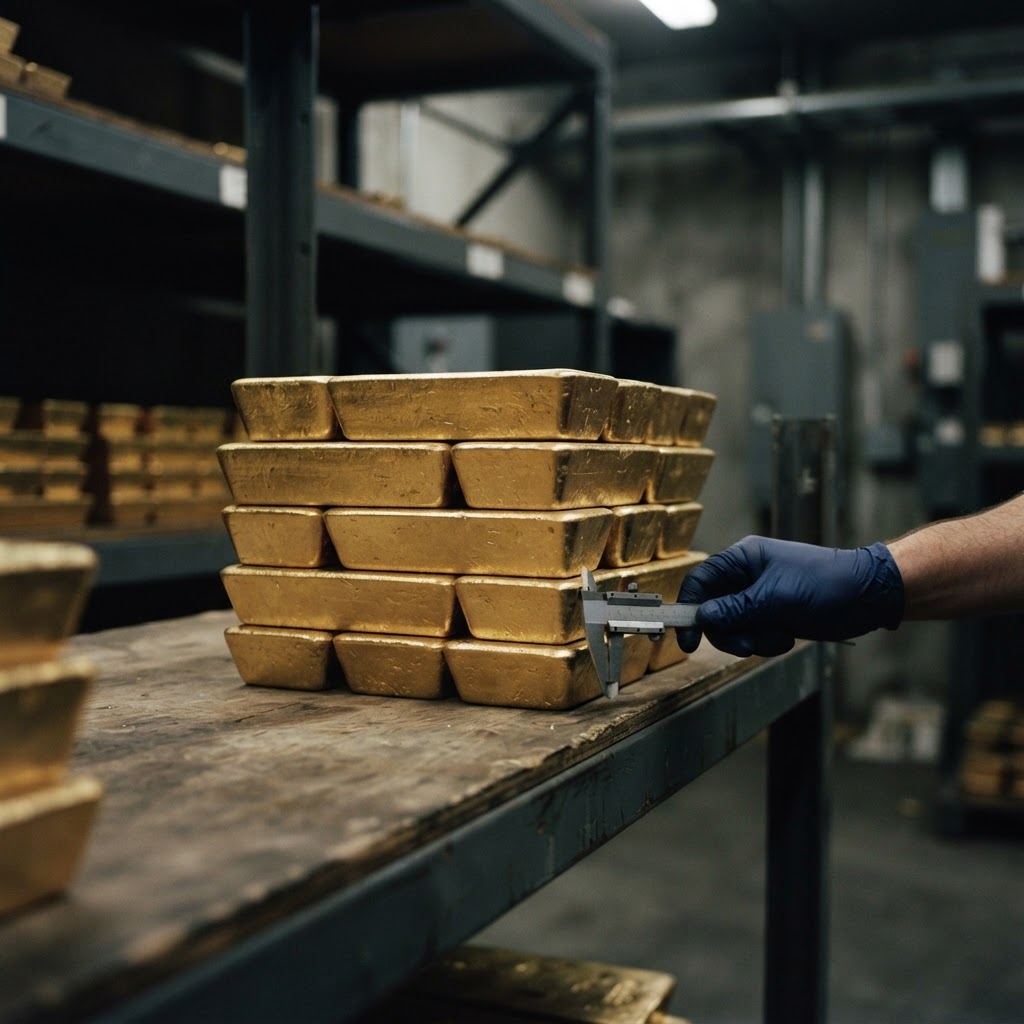
The counterfeit stamp. Tungsten-cored bars plated with gold, or outright base-metal slabs, stamped to imitate a listed refiner's marks. The stamp is the cheapest part of the fraud to produce. Only weight, dimensions, density, and assay expose it.
The lapsed status. Offers citing a refiner that was on the list years ago but has since been suspended or removed. The phrase "Good Delivery" is doing the work of a current fact-check nobody performed. The list's current state, including suspensions, is publicly checkable and should be checked in real time on every deal.
The name-drop on material the list doesn't cover. Sellers of doré, dust, or unspecified gold invoke "LBMA standard" as atmosphere. The accreditation covers 400-ounce bars from listed refiners. It has nothing to say about unrefined material, and quoting it in connection with doré is a credibility signal in the wrong direction.
The Safeguard: Current Status Plus Independent Assay, Broken Down
The protection that actually works treats the accreditation as a filter, not a verdict:
1. Verify the refiner's status today. Check the current Good Delivery List, including suspension history, before the offer is taken seriously. A refiner that was listed when a counterparty's marketing material was printed may not be listed now.
2. Treat the physical bar as unverified until tested. Weight, dimensions, and density checks catch most counterfeits cheaply. A drill-and-assay or melt test through an independent, accredited laboratory settles fineness. The melt-and-pay structure covered elsewhere on this desk, settlement against independently verified fine ounces after melting, is the cleanest way to make the assay the seller's problem too.
3. Separate the quality question from the title question. Accreditation speaks to the first only. Chain of custody documentation, verifiable ownership history, and clean provenance on the seller's side remain the desk's own work regardless of who refined the bar.
Used this way, the Good Delivery List earns the trust the market places in it: as a strong prior about a refinery, feeding into a transaction that never stops testing the physical evidence in front of the trader.
References & Source Records
London Bullion Market Association (lbma.org.uk): Good Delivery Rules, current Good Delivery List, and suspension notices.
LBMA Responsible Sourcing Programme documentation.
OECD Due Diligence Guidance for Responsible Supply Chains of Minerals from Conflict-Affected and High-Risk Areas (oecd.org).


Comments